
Modelo 210 Guide
Modelo 210 in Spain: What Non-Residents Need to Know
Modelo 210 is the tax obligation most non-resident property owners in Spain ignore — and thereby take on considerable risk. This guide explains everything you need to know.
Do you need to file Modelo 210?
What is Modelo 210?
Modelo 210 (officially: "Impuesto sobre la Renta de no Residentes" — IRNR) is the Spanish income tax return for persons who do not have their tax residence in Spain but generate income there or hold assets there. In the context of property ownership, this affects almost all non-resident owners: anyone who owns a Spanish property either generates actual rental income or so-called imputed income under Spanish tax law — in both cases Modelo 210 must be filed.
Who must file Modelo 210?
The obligation to file Modelo 210 applies to all individuals who:
- Do not have their tax residence in Spain,
- Own a property in Spain (apartment, house, flat, land),
- And either rent out this property or use it themselves (including leaving it vacant).
Even if you have not visited the property once during the year, the tax obligation applies. There are few exceptions for non-residents from EU/EEA countries or third countries — only the applicable tax rate may vary.
Does this apply even without rental income?
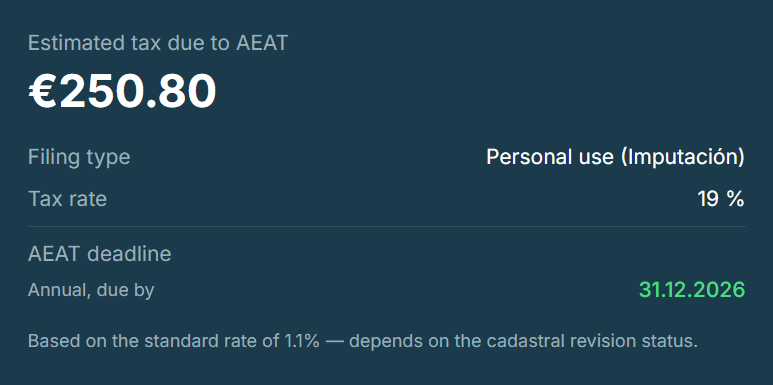
Yes — and this is the point many owners miss. Anyone who does not rent out their property must still file Modelo 210 annually. The basis is the so-called imputed income ("renta imputada"): the Spanish tax authority assumes that the property represents a fictitious economic benefit. This is calculated based on the cadastral value — generally 1.1% or 2% of the cadastral value depending on when the valuation was last updated. The applicable tax rate is then applied to this amount.
Modelo 210 for rental income vs. imputed income
There are two fundamentally different scenarios:
Imputed income (no rental): Calculated on the basis of the cadastral value. Filed once a year. Deadline: until tax year 2025, 31 December of the following year; from tax year 2026, 1 April to 31 December of the following year (Order HAC/623/2026).
Rental income: The rent actually received is treated as income. Owners from EU/EEA countries can deduct certain expenses (mortgage interest, management costs, depreciation). Owners from third countries (e.g. USA, UK post-Brexit) cannot deduct expenses. Since 2024, annual grouped filing is available — deadline: until tax year 2025, 1–20 January of the following year; from tax year 2026, 1–20 April of the following year (Order HAC/623/2026).
Deadlines and filing periods
Deadlines differ depending on the type of income and tax year:
Until tax year 2025:
| Income type | Filing period | Deadline |
|---|---|---|
| Imputed income | Annual | 1 January – 31 December of following year |
| Rental income (annual grouped) | Annual | 1–20 January of following year |
| Rental income Q1 (Jan–Mar) | April | 20 April |
| Rental income Q2 (Apr–Jun) | July | 20 July |
| Rental income Q3 (Jul–Sep) | October | 20 October |
| Rental income Q4 (Oct–Dec) | January | 20 January of following year |
From tax year 2026 (Order HAC/623/2026):
| Income type | Filing period | Deadline |
|---|---|---|
| Imputed income | Annual | 1 April – 31 December of following year |
| Rental income (annual grouped) | Annual | 1–20 April of following year |
| Rental income Q1–Q3/2026 | Quarterly | Old quarterly deadlines (20 Apr, 20 Jul, 20 Oct 2026) |
| Rental income Q4/2026 | April following year | 1–20 April 2027 |
Important: For imputed income, you can file up to five previous tax years at once, though surcharges apply.
What documents are required?
You will generally need the following documents to file Modelo 210:
- NIE (Número de Identificación de Extranjeros): Your Spanish tax number — filing is impossible without a NIE.
- Catastro certificate: Document showing the current cadastral value of your property ("valor catastral"). Available from the Catastro or via the Spanish tax authority.
- Title deed (Escritura): For property details.
- For rental income: Proof of rent received, receipts for deductible expenses (EU/EEA owners).
- Bank details: IBAN of a Spanish or European bank account for payment.
How payment and filing work
Modelo 210 is filed electronically via the online portal of the Spanish tax authority (Agencia Tributaria). You will need either a digital certificate ("certificado digital"), Cl@ve PIN, or a tax advisor.
Payment is made either directly at filing (bank transfer or direct debit from a Spanish account) or via a Spanish bank with the printed submission confirmation. EU owners can in many cases use a direct payment by IBAN from a non-Spanish European bank.
Common mistakes
The most common mistakes when filing Modelo 210:
- Not filing at all: The most common mistake. Many owners are unaware of their obligation.
- Wrong cadastral value: Outdated or incorrect values lead to miscalculations.
- Wrong tax rate: The applicable rate depends on your country of residence and double taxation treaties.
- Missing quarters: For rental income, individual quarters are forgotten.
- Claiming deductions as a third-country owner: EU/EEA rules do not apply to owners from non-EU countries.
- NIE missing or expired: Filing is impossible without a valid NIE.
How our tool will simplify the process
Our guided assistant walks you through the entire Modelo 210 process: from assessing your situation to calculating your tax to completing the filing.
Calculate Tax → →Further Reading